



As technology continues to evolve, businesses and individuals replace computers, servers, laptops, networking equipment, and other electronic devices more frequently than ever. Responsible IT hardware recycling is essential—not only to protect the environment but also to recover valuable materials, extend the life of equipment, and ensure sensitive data is securely destroyed before disposal.
Electronic waste (e-waste) contains hazardous substances such as lead, mercury, cadmium, and other toxic materials that can contaminate soil and water if disposed of improperly. By recycling obsolete IT equipment through certified recycling processes, these harmful materials are safely managed, reducing pollution and protecting both people and the environment.
Refurbishment and Renovation
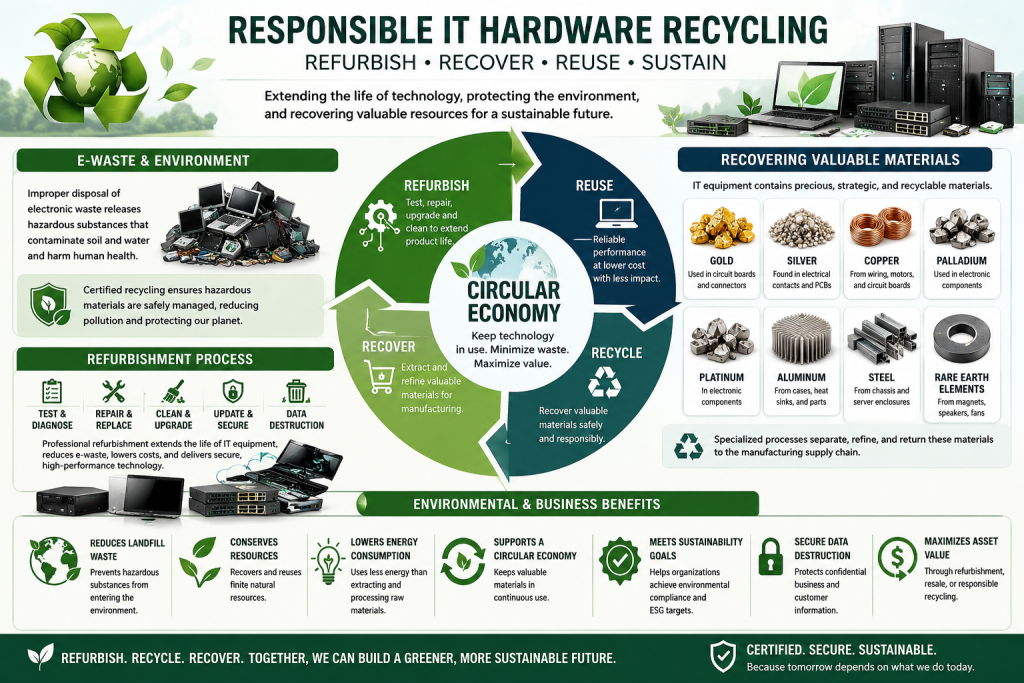
Not every device that reaches the end of its first lifecycle needs to be recycled immediately. Many computers, laptops, servers, and networking devices can be professionally refurbished or renovated to extend their useful life. This process may include:
- Comprehensive hardware testing and diagnostics.
- Replacement of faulty or worn components such as hard drives, SSDs, memory (RAM), power supplies, batteries, cooling fans, and keyboards.
- Internal cleaning to remove dust and improve system performance.
- Installation of updated operating systems, firmware, and security patches.
- Performance upgrades, including additional memory or faster storage.
- Secure data destruction to ensure all previous information is permanently erased before the equipment is reused.
Refurbishing equipment reduces electronic waste, lowers the demand for manufacturing new devices, decreases carbon emissions associated with production, and provides organizations with reliable, cost-effective technology.
Recovering Rare and Valuable Materials
When equipment is beyond repair or refurbishment, it is dismantled and processed to recover valuable raw materials that can be reused in manufacturing new products. Modern IT equipment contains many precious and strategic materials, including:
- Gold – used in circuit boards and connectors because of its excellent conductivity and resistance to corrosion.
- Silver – commonly found in electrical contacts and printed circuit boards.
- Copper – recovered from wiring, motors, transformers, and circuit boards for reuse in electrical products.
- Palladium – used in electronic components and multilayer ceramic capacitors.
- Platinum – found in certain electronic components and industrial equipment.
- Aluminum – recovered from computer cases, heat sinks, and structural components.
- Steel – recycled from chassis, racks, and server enclosures.
- Rare earth elements such as neodymium, dysprosium, and praseodymium – recovered from hard drive magnets, speakers, and cooling fans.
These materials are separated through specialized mechanical, magnetic, and metallurgical recycling processes. Once recovered, they are refined and returned to the manufacturing supply chain, reducing the need for environmentally intensive mining operations, conserving natural resources, and lowering greenhouse gas emissions.
Environmental and Business Benefits
Responsible IT asset refurbishment and recycling provide significant environmental and economic advantages by:
- Reducing landfill waste and preventing hazardous substances from entering the environment.
- Conserving finite natural resources through material recovery and reuse.
- Lowering energy consumption compared with extracting and processing virgin raw materials.
- Supporting a circular economy by keeping valuable materials in continuous use.
- Helping organizations meet sustainability goals and environmental compliance requirements.
- Providing secure, certified data destruction to protect confidential business and customer information.
- Maximizing the value of retired IT assets through refurbishment, resale, or responsible recycling.
By combining professional refurbishment with certified recycling and material recovery, organizations can minimize environmental impact, protect sensitive information, and ensure valuable resources remain available for future generations.