



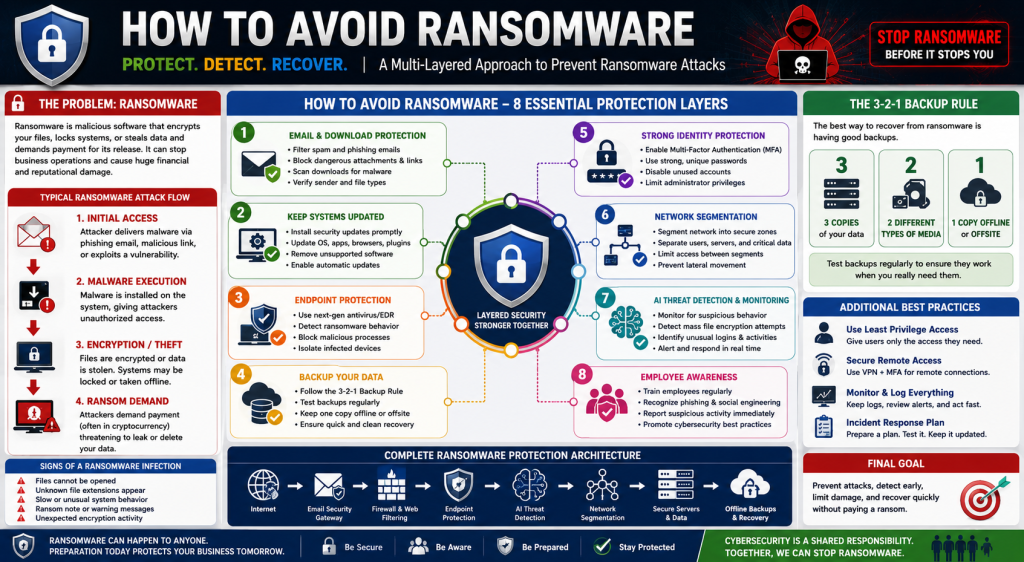
Protect. Detect. Recover. | A Multi-Layered Approach to Prevent Ransomware Attacks
The Problem: Ransomware
Ransomware is one of the most damaging cyber threats facing businesses today. It is malicious software that encrypts files, locks systems, or steals sensitive data before demanding payment for its release. Modern ransomware attacks often target entire organizations, causing operational disruption, financial loss, and reputational damage.
A typical ransomware attack follows this process:
Attacker
↓
Phishing email, malicious download, or exploited vulnerability
↓
Malware installed on a computer or server
↓
Files are encrypted or data is stolen
↓
Ransom demand is issued
The best defense is preventing the attack before it reaches critical systems through multiple layers of security.
1. Email and Download Protection
Most ransomware begins with a malicious email attachment or download.
Protect your business by:
- Filtering spam and phishing emails
- Blocking dangerous attachments
- Scanning downloads for malware
- Verifying file types before opening
- Preventing users from downloading untrusted software
Never open unexpected attachments or click unknown links without verifying the sender.
2. Keep Systems Updated
Attackers frequently exploit outdated software.
Reduce risk by:
- Installing security updates immediately
- Keeping operating systems current
- Updating browsers and plugins
- Removing unsupported software
- Regularly updating business applications
Every update closes security vulnerabilities that attackers actively search for.
3. Endpoint Protection
Every computer should have advanced endpoint security.
A modern endpoint solution should:
- Detect ransomware behavior
- Block malicious programs
- Stop suspicious file encryption
- Monitor unusual activity
- Automatically isolate infected devices
If one computer becomes infected, isolation prevents ransomware from spreading across the network.
4. Backup Your Data
Backups are your strongest recovery tool.
Follow the 3-2-1 Backup Rule:
- Keep 3 copies of your data.
- Store them on 2 different types of media.
- Keep 1 copy offline or offsite where ransomware cannot reach it.
Test backups regularly to ensure they can be restored quickly.
5. Strong Identity Protection
Many ransomware attacks begin with stolen passwords.
Protect accounts by:
- Enabling Multi-Factor Authentication (MFA)
- Using strong, unique passwords
- Disabling unused accounts
- Limiting administrator privileges
- Reviewing login activity regularly
Even if a password is stolen, MFA helps prevent unauthorized access.
6. Network Segmentation
Do not allow every computer to communicate freely.
Separate your network into secure zones:
- Employee devices
- Servers
- Finance systems
- Guest Wi-Fi
- Critical business applications
If ransomware infects one area, segmentation limits its ability to spread.
7. AI Threat Detection and Monitoring
Modern security systems use artificial intelligence to identify unusual behavior before major damage occurs.
AI can detect:
- Mass file encryption
- Unusual login locations
- Unexpected privilege changes
- Large data transfers
- Suspicious software execution
Early detection allows security teams to respond before ransomware reaches critical systems.
8. Employee Awareness
Employees are the first line of defense.
Train staff to:
- Recognize phishing emails
- Avoid suspicious downloads
- Report unusual computer behavior
- Verify unexpected payment requests
- Never disable security software
Regular awareness training significantly reduces the likelihood of successful ransomware attacks.
Complete Ransomware Protection Architecture
Internet
↓
Email Security Gateway
↓
Firewall & Web Filtering
↓
Endpoint Protection
↓
AI Threat Detection
↓
Network Segmentation
↓
Secure Servers & Data Storage
↓
Offline Backups & Disaster Recovery
Business Security Implementation
A strong ransomware defense includes:
- Email filtering
- Web filtering
- Next-generation firewall
- Endpoint Detection and Response (EDR)
- Offline and cloud backups
- Multi-Factor Authentication
- Patch management
- AI-powered monitoring
- Security awareness training
- Incident response planning
For organizations using Fortinet, this can include:
- FortiGate – Network firewall and intrusion prevention
- FortiClient – Endpoint protection and ransomware detection
- FortiEDR – Advanced endpoint detection and response
- FortiMail – Email security
- FortiAnalyzer – Centralized logging and monitoring
- FortiGuard – Real-time threat intelligence
Final Goal
The objective of ransomware protection is not simply to stop malware. The goal is to create multiple layers of defense that prevent attacks, detect suspicious behavior early, limit the spread of infections, protect critical data, and ensure the business can recover quickly without paying a ransom.
A secure organization combines proactive security, continuous monitoring, reliable backups, and informed employees to minimize the impact of ransomware and keep business operations running safely.